

How the In2Care Mosquito Station Works and Why It Matters
Mosquitoes remain one of the world's most significant public health threats. They transmit diseases that affect hundreds of millions of people every year, including malaria, dengue, Zika, chikungunya, and West Nile virus. At the same time, nuisance mosquito populations continue to create challenges for homeowners, businesses, public spaces, and mosquito management professionals.
At Envu, helping customers manage mosquitoes is an important part of our broader commitment to advancing healthy environments. That's one of the reasons we acquired In2Care® in 2025. We recognized that the In2Care Mosquito Station represented a new and different way of thinking about mosquito management — one that leverages mosquito behavior itself as part of the solution and aligns with our commitment to Be a Force With Nature.
Understanding the Challenge
Before exploring how the In2Care Mosquito Station works, it's important to understand the scale of the challenge that mosquito management professionals, researchers, and public health experts are working to address.
Michelle Brown, Ph.D., District Manager for California's West Valley Mosquito & Vector Control District and Executive Director of the Society for Vector Ecology, explains why mosquito-borne diseases remain a significant public health concern.
Looking Beyond Traditional Mosquito Control
Mosquito management programs typically combine source reduction, public education, larvicides, targeted spraying, and personal prevention measures. Individuals also play an important role by eliminating standing water and using insect repellents. “One of the biggest components of controlling mosquitoes is eliminating the breeding sites of mosquitoes, and mosquitoes can breed in as little as a bottle-cap full of water,” says Billy
Blasingame, owner and CEO of Georgia-based Blasingame Pest Management in the southern United States. However, one challenge has persisted for decades: many mosquito breeding sites are difficult to locate or access, making them hard to treat through traditional approaches. That reality has led researchers to explore a different question: What if mosquito behavior itself could become part of the solution?
How the In2Care Mosquito Station Works
The In2Care Mosquito Station is designed around a behavior-led approach known as auto-dissemination. Rather than relying solely on finding and treating every potential breeding site, the station leverages the mosquito's natural behavior to help deliver control agents to additional breeding locations. Envu CEO Gilles Galliou explains further below.
The In2Care Mosquito Station helps control both Aedes and Culex mosquito species — two mosquito groups associated with diseases such as dengue, Zika, chikungunya, and West Nile virus.
The station provides direct adult and larval control, helping reduce mosquito populations through multiple modes of action. For Aedes mosquitoes, it also leverages their natural egg-laying behavior to help spread larvicide to additional breeding sites, extending control beyond the station itself and to locations that may otherwise be difficult to locate or access.
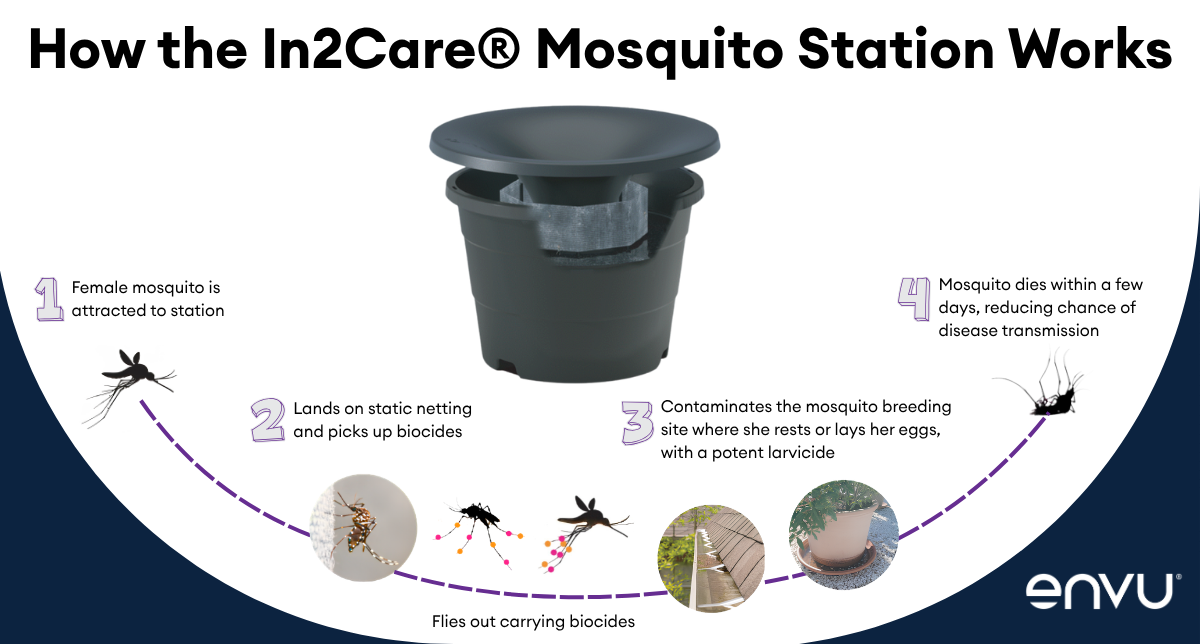
That targeted approach is one of the reasons the technology can be deployed in locations where mosquito pressure presents serious challenges, from residential neighborhoods and school grounds to parks, zoos, and other public spaces; it provides precise control while minimizing impacts on pollinators and other non-target organisms.
Why It Matters
Understanding how the technology works is only part of the story.
As the world's first global innovation company of its size and scale dedicated solely to environmental science, Envu works closely with mosquito management professionals, lawn care operators, public health agencies, and other customers to understand the challenges they face and develop solutions that help address them.
The perspective below reflects what we’ve heard from many of our customers: effective mosquito management requires more than simply reducing mosquito populations. Billy Blasingame, owner and CEO of Griffin, Georgia-based Blasingame Pest Management, shares how his team emphasizes education and prevention alongside targeted control — and why the In2Care® Mosquito Station has become an important tool in helping address disease-carrying mosquito species.
The In2Care Mosquito Station is designed to support those broader efforts. By helping extend control to breeding sites that may otherwise remain hidden or difficult to access, the technology provides another tool that professionals can incorporate into prevention-focused mosquito management programs.
By turning mosquito behavior into part of the solution, the In2Care Mosquito Station demonstrates how new approaches can help address persistent challenges in mosquito management. For Envu, that is the ultimate goal of innovation: helping our customers solve real-world challenges in ways that advance healthy environments for everyone, everywhere.


